
Across the healthcare clients I’ve worked with, one pattern shows up consistently: Most healthcare websites publish medical content regularly, but only a handful rank.
The difference lies in the architecture of the content itself.
This article breaks down what that architecture looks like, why it matters more in healthcare than in any other niche, and what it takes to get healthcare blog SEO right the first time.
Google classifies medical, financial, and legal content as YMYL (Your Money or Your Life). YMYL are topics where inaccurate information can cause genuine harm.
For healthcare websites, this means Google’s ranking systems apply significantly more scrutiny.
A blog post discussing symptoms, treatments, or disease management is not ranked solely on keyword relevance. Google’s systems also assess credibility, authorship, and the reliability of sources.
This is where EEAT medical content becomes the foundation.
EEAT stands for Experience, Expertise, Authoritativeness and Trustworthiness.
Google articulated this framework in its Search Quality Evaluator Guidelines, and for healthcare content, the bar is considerably higher than for lifestyle or entertainment topics.
In my experience editing and optimising content across specialities, authorship is the single most scrutinised signal.
For example, a blog post authored by a vascular surgeon, citing peer-reviewed literature on varicose veins, will outperform one authored by a neurophysician — regardless of keyword density.
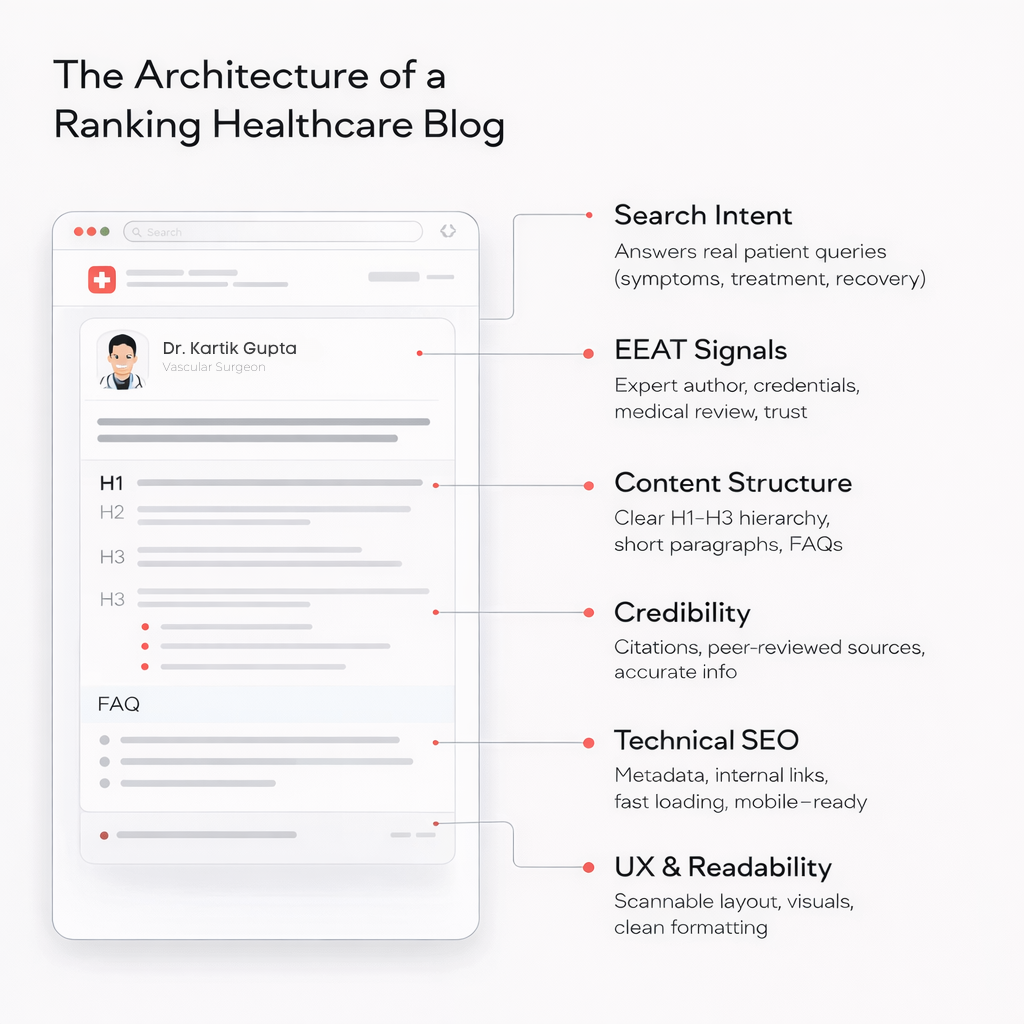
Healthcare blogs that rank consistently are structured for both readers and search algorithms.
For medical blogs, content must demonstrate clarity, credibility, and relevance from the start. This can be achieved through four foundational steps:
Clear headings, short paragraphs, and logical flow make medical information easier for patients to understand and for search engines to crawl, index, and interpret.
The article must directly answer the question behind the search query — whether it relates to symptoms, treatment options, prevention, or recovery.
Clear headings, short paragraphs, and logical flow make medical information easier for patients to understand and for search engines to crawl, index, and interpret.
Citations from peer-reviewed research, expert insights, and medically accurate explanations strengthen trust and authority.
Optimised metadata, internal linking, fast page load times, and a mobile-friendly design ensure the content is accessible and discoverable.
Think of the next sections as a practical checklist to audit whether your healthcare blog is built to rank on Google.
Google ranks content that directly answers the reason someone searched in the first place — the search intent.
With AI Mode and LLMs now integrated into search, users are asking longer questions, describing symptoms in detail, and even searching using specific case scenarios.
Your blog, therefore, needs to target long-tail keywords, contextual questions, and multiple patient scenarios to signal depth of expertise.
Search queries generally fall into four categories:
But, in healthcare, based on the client work I’ve done so far, the informational intent expands into 4 more categories:
Search Intent | Query | Ideal Content Type |
Informational — Research |
| Educational blog explaining possible causes and when to see a doctor |
Informational — Tests/Treatment Procedure Awareness |
| Explainer blogs describing the procedure steps, how to prepare, what to expect, indications, etc. |
Informational — Treatment Comparisons |
| Patient guide outlining cost, recovery timeline and rehabilitation |
Informational — how-to / post-operative care |
| Step-by-step rehabilitation guide with visuals |
Transactional |
| Clinic service page with treatment details |
Transactional |
| Doctor profile or hospital department page |
Commercial |
| Product comparison or buying guide |
Navigational |
| Specific website or clinic page |
These examples are drawn from real queries I’ve encountered, and each requires a different content structure.
A patient searching for symptoms expects explanations and warning signs, while someone researching treatment wants comparisons, recovery period, and side effects.
When search intent aligns with content structure:
Search engines do not read content the way humans do. They rely on headings, hierarchy, and formatting to understand the topic, identify key sections, and determine whether the article effectively answers the search query.
A well-structured healthcare blog improves:
H1 – Main topic
H2 – Major sections answering the search query
H3 – Supporting details/explanations or subtopics
Many searches are phrased as questions in “People Also Ask” or “People Also Search” sections.
FAQs are particularly useful for:
FAQ sections also enable FAQ schema, which increases visibility in search results.
This is one section I emphasise the most with new clients.
The author’s qualifications help establish whether the content is authored by someone with relevant clinical knowledge or experience.
For medical blogs, this may include:
Displaying the author’s name, credentials with/without a short bio helps search engines, and readers recognise the expertise behind the article.
However, many website templates do not support displaying credentials on the blog page. This is something I encounter regularly, and here’s how I work around it with clients:
If your content is written by a medical writer, you can also include a medical review layer and mention it at the beginning or end of the article.
This means the content is:
Healthcare content should cite peer-reviewed sources whenever discussing treatments, risks, or outcomes, and especially if quoting statistics.
Examples of credible sources include:
Citations can be incorporated into the text & listed at the end of the article in a “References” section to support key claims.
Healthcare blogs should avoid exaggerated claims, clickbait, and overly promotional language.
Transparent communication includes:
This approach strengthens both reader trust and search engine credibility signals.
Concealing or avoiding discussion of known risks or side effects can mislead readers and damage trust if patients later discover that important information was omitted.
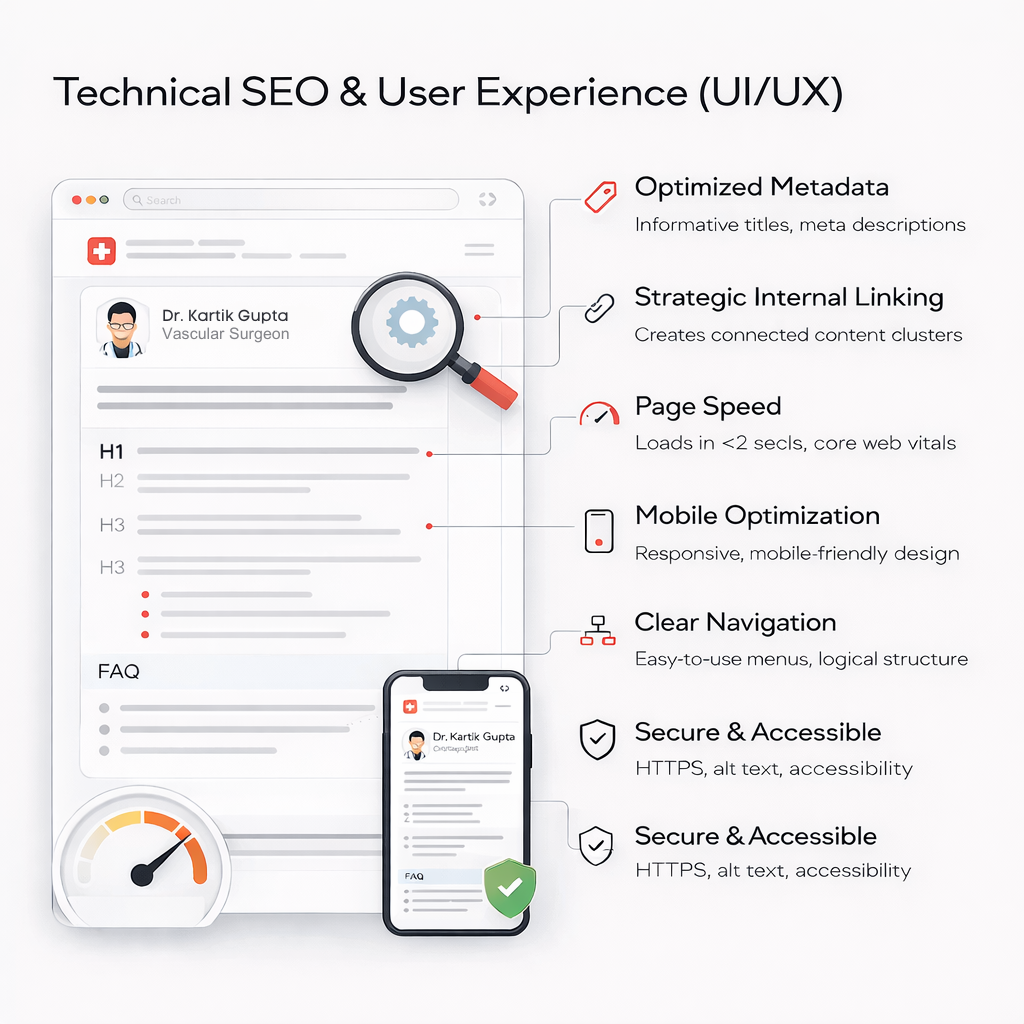
Search engines evaluate how easily the page can be crawled, loaded, and navigated.
The most important technical elements that support ranking healthcare blogs include:
Metadata helps search engines understand what the page is about before the user even clicks on it.
Important elements include:
Clear metadata improves both indexing and click-through rates from search results.
Internal links help search engines understand the relationship between different pages on a website.
For example, a blog on “Exercises After Knee Replacement Surgery” may internally link to:
This structure builds topical authority, allowing search engines to recognise the website as a reliable source on that subject.
In the content drafts I create for clients, I specify a minimum of 3 images, including diagrams or medical illustrations to explain concepts visually:
Since search engines cannot interpret images directly, alt text is added in the back end.
Alt text descriptions help search engines understand the content of the image while also improving accessibility for visually impaired users.
Example alt text:
“Diagram showing stages of varicose veins formation in the leg.”
Healthcare searches occur primarily on mobile devices.
A mobile-optimised webpage ensures that:
Poor mobile optimisation can significantly reduce search visibility and user engagement.
Healthcare readers often search for quick answers to symptoms or treatments.
Slow-loading pages increase bounce rates and reduce the likelihood that users will stay long enough to read the content.
Here are a few simple tips to improve page loading speed and overall user experience:
Ranking a healthcare blog on Google requires a deliberate structure that combines search intent, content architecture, credibility, and strong technical foundations.
When a blog directly answers the patient’s question, presents information in a structured and readable format, and meets Google’s EEAT standards, it earns both reader trust and search visibility.
Technical elements like internal linking, metadata, mobile optimisation, and page speed, then help search engines surface that content to the right audience.
These are the same principles I apply when building content strategies for healthcare clients, whether for a solo practitioner in Nagpur or a commercial project for Apollo. The framework doesn’t change, but the context does.
If you’re looking to build healthcare content that ranks and converts, let’s connect.