
Types of Medical Writing: The Ultimate Guide to Finding Your Niche
Introduction
What Is Medical Writing?
Medical writing is creating content that accurately and clearly communicates technical and non-technical health information for a specific purpose and audience.
A medical writer might spend their Monday drafting a research paper on endodontic files. Their colleague might spend the same Monday writing a patient education brochure on AV Fistula for dialysis patients. Both are medical writers.
That’s why “medical writing” as a single category is misleading, and it is important to be informed about the various niches before you enter the field.
Types of Medical Writing
Broadly, medical writing can be understood under two primary categories:
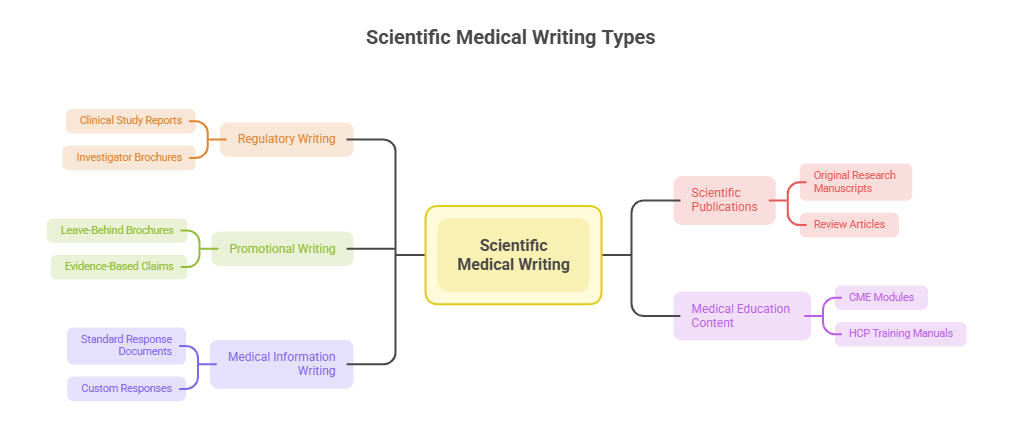
- Scientific medical writing: Evidence-based and structured. The audience is professional: a regulator, a peer reviewer, a clinician, and the writing has an academic, documentation, or record purpose. Example: Clinical research report for clinical trials; case report for scientific publication in a journal.
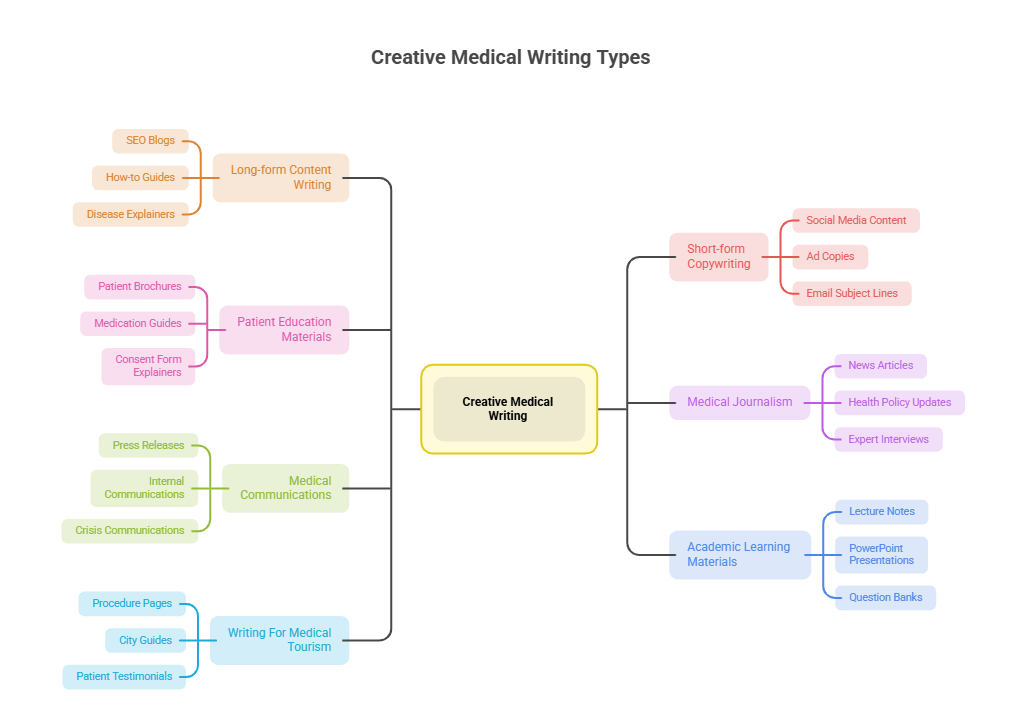
- Creative medical writing: Audience-first, intent-driven communication. The goal is clarity, engagement, and often persuasion—there are no rules! The audience could be a patient, a caregiver, or a healthcare brand trying to build trust. Example: Patient education brochure, website blogs, social media content, newspaper ads, etc.
Here’s an overview:
Scientific Medical Writing
Scientific medical writing is the backbone of pharmaceutical and academic research. It is evidence-based, highly structured, and governed by strict guidelines.
If you have a research background or have worked in clinical trials, academic publishing, or a hospital setting, this will feel familiar.
Creative Medical Writing
Creative writing is that section of medical writing that is often overlooked in most guides.
It is an audience-first and intent-driven field. For example, writing a blog/article that ranks on Google, a brochure that a patient reads in a waiting room, or an ad copy that convinces someone to book a consultation; the writing has to work hard to hold attention.
Creative medical writing is the voice of healthcare, and in my experience, clinicians with strong communication instincts tend to thrive the fastest.
This branch is also the most freelance-friendly in the entire field, and the most accessible entry point for clinicians making the switch.
How to Choose Your Niche in Medical Writing
If you have read this far, you are probably doing one of two things: nodding along, thinking “yes, that one!” at multiple niches, or staring at the screen, wondering how on earth you are supposed to pick just one.
Both reactions are completely normal. Here is a framework that actually helps:
Start with what you already know
Your clinical background is your biggest asset. A pedodontist who pivots to medical writing does not start from zero. They start with years of clinical knowledge that a generalist writer cannot replicate. Begin with your speciality. Write what you already understand deeply, and let that be your entry point.
Match the work to your personality
Are you detail-oriented, methodical, and comfortable with strict guidelines? Choose scientific medical writing: regulatory, publications, or medical information will suit you well.
Do you prefer variety, storytelling, and the freedom to experiment? Choose creative medical writing: long-form content, journalism, and patient education is your track.
Be honest and think about your end goal.
Don't wait for perfect clarity
Most successful medical writers did not choose their niche from a list. They tried something, decided to pivot, tried something else and got better at it, started getting clients or opportunities in that area, and gradually specialised. The niche often chooses you if you start.
You do not have to pick just one
Many medical writers intentionally hold two niches: one for income stability, one for creative satisfaction. I personally work across creative medical writing niches!
It is absolutely possible, especially once you have some experience and a decent portfolio.
If you are at that crossroads right now, I hope this guide helped you. You already have the hardest part covered: years of clinical training that most writers simply do not have. That is your edge.
And if you are still not sure where to start, or you have questions, you know where to find me.
Take Home Message
Medical writing is not one career; it is an amalgamation of many. And the good news is that you do not have to figure it all out before you begin.
You now know the difference between scientific and creative medical writing, and roughly which side your background and personality lean towards. The real question now is: which niche within that side is yours?
Take the 2-minute quiz below to find out which medical writing niche is the best fit for you.
Visit the blog section to explore how scientific medical writing differs from creative medical writing, the skills required, and how to get started